
Key Takeaways
- 01A profitable pest control price is built from four numbers: fully loaded labor, chemical and material cost per job, overhead per job, and your profit margin
- 02Recurring plans (monthly, bi-monthly, quarterly) are priced per visit but won on route density — tight routes cut your drive time and make lower per-visit prices profitable
- 03Charge more for the initial visit than for follow-ups: it takes longer, uses more product, and usually includes the inspection
- 04Specialty jobs like termites and bed bugs are bid per job, never from a flat rate card — inspect first, then quote
- 05Put every quote in writing as an itemized estimate, and get a signed service agreement before starting any recurring plan
To price a pest control job, add up your labor for the time on site, the chemicals and materials the treatment uses, your drive time, and your overhead per job — then apply the profit margin your business needs to hit. One-time jobs carry the whole cost of the trip in a single price; recurring plans spread it across visits, which is why a quarterly stop can cost the customer less per visit and still pay you well.
That's the whole method. The rest of this guide walks through each number, shows a worked example for a typical general pest job, and covers the two places new operators most often lose money: underpriced initial visits and recurring routes with too much windshield time.
What Goes Into a Pest Control Price
Every pest control quote is covering five real costs, whether you've written them down or not:
- Labor — the tech's time on site, priced at a fully loaded rate (wages plus payroll taxes, insurance, and benefits), not base pay.
- Chemicals and materials — the products applied, bait stations placed, and consumables like gloves, dusters, and monitors.
- Drive time — the trip to and from the job. A 20-minute treatment with 50 minutes of driving is a 70-minute job.
- Overhead — your license fees, business insurance, vehicle, phone, software, and marketing, divided across the jobs you run each month. Our guide on how to calculate overhead costs walks through the math.
- Retreat risk — most residential plans include free re-service between visits if pests come back. That guarantee has a cost; your price has to carry it.
If your price doesn't cover all five, the difference comes out of your pocket.
What Customers Expect to Pay
You set your price from your costs, but it helps to know the ranges customers see when they shop around. Published national cost guides put typical residential pest control in these ballparks — actual prices vary a lot by region, home size, and pest:
Typical Residential Pest Control Price Ranges (U.S. cost-guide figures)
| Service | Typical range | Notes |
|---|---|---|
| One-time general treatment | $100–$300 | Single visit for ants, spiders, roaches, etc. |
| Initial visit on a recurring plan | $150–$300 | Longer visit; includes inspection and first treatment |
| Monthly plan | $40–$75 per visit | Highest route density, lowest per-visit price |
| Quarterly plan | $100–$175 per visit | The most common residential plan |
| Bed bug treatment | $1,000–$4,000+ | Bid per job after inspection; often multiple treatments |
| Termite treatment | $250–$2,500+ | Spot treatments to full barriers; always inspect first |
These figures are what homeowners see in national cost guides — they are a sanity check, not a substitute for your own math. A quarterly price that's profitable for a company running 12 tight stops a day will bankrupt a solo operator driving 40 minutes between houses.
How to Price Pest Control Jobs in 7 Steps
1. Calculate Your Fully Loaded Labor Rate
Start with what an hour of technician time actually costs you. That's the hourly wage plus payroll taxes, workers' comp, and any benefits — usually 25–40% on top of base pay. A free labor cost calculator does this in a couple of minutes.
If you pay a tech $22/hour, the fully loaded cost is realistically $28–$31/hour. If you're a solo owner-operator, pay yourself a real wage in this step — "free" owner labor is how pest control businesses end up busy and broke.
2. Price the Chemicals and Materials Per Job
Work out the product cost of your standard treatments. A general perimeter spray might use a few dollars of concentrate once diluted; bait stations, gel baits, dusts, and monitors add more. Track what your three or four most common treatment types consume, and use those as line-item costs.
Don't forget consumables — gloves, respirator cartridges, bait station replacements — and a share of equipment wear on sprayers and foamers.
3. Add Overhead and Drive Time Per Job
Add up your monthly overhead: state license and certification renewals, business insurance, vehicle payment and fuel, phone, software, and marketing. Divide by the number of jobs you actually run in a month to get overhead per job.
Then be honest about drive time. If your average stop involves 30 minutes of driving, that's 30 minutes of labor cost added to every job — which is exactly why tightening your route is the fastest way to raise your effective hourly rate without raising prices.
4. Decide How You'll Price One-Time Jobs vs. Recurring Plans
One-time jobs must carry the full cost of the trip plus your margin in a single price — that's why a one-time visit costs more than a plan visit for the same house.
Recurring plans are the backbone of a pest control business: predictable revenue, denser routes, and customers you don't have to re-sell. Price the initial visit higher (it includes the inspection and a heavier first treatment), then set the recurring per-visit price from your costs at realistic route density. Spell out what the plan covers, what counts as a free re-service, and the cancellation terms in a written pest control contract.
5. Bid Specialty Work Per Job — Never From a Rate Card
Termites, bed bugs, wildlife exclusion, and heavy infestations are inspection-first jobs. The price depends on the size of the structure, the severity, the treatment method, and how many follow-up visits it will take. Inspect, scope the work, then build the quote from labor hours and materials like any other bid.
Whether you can charge for the inspection itself varies by market — many companies offer free termite inspections and price the recovery into the treatment. Either way, decide deliberately; a free hour of inspection is a cost like any other.
6. Apply Your Markup and Check It Against the Market
Add your target margin on top of total job cost — a markup calculator converts between the markup you add and the margin you actually earn, which are not the same number. Then compare the result against what competitors in your area charge for similar service.
If your math lands far above market, look for cost problems (route density, product waste) before assuming you should eat the difference. If it lands far below, raise it — underpricing just fills your schedule with unprofitable stops.
7. Present the Quote Professionally and Get It Signed
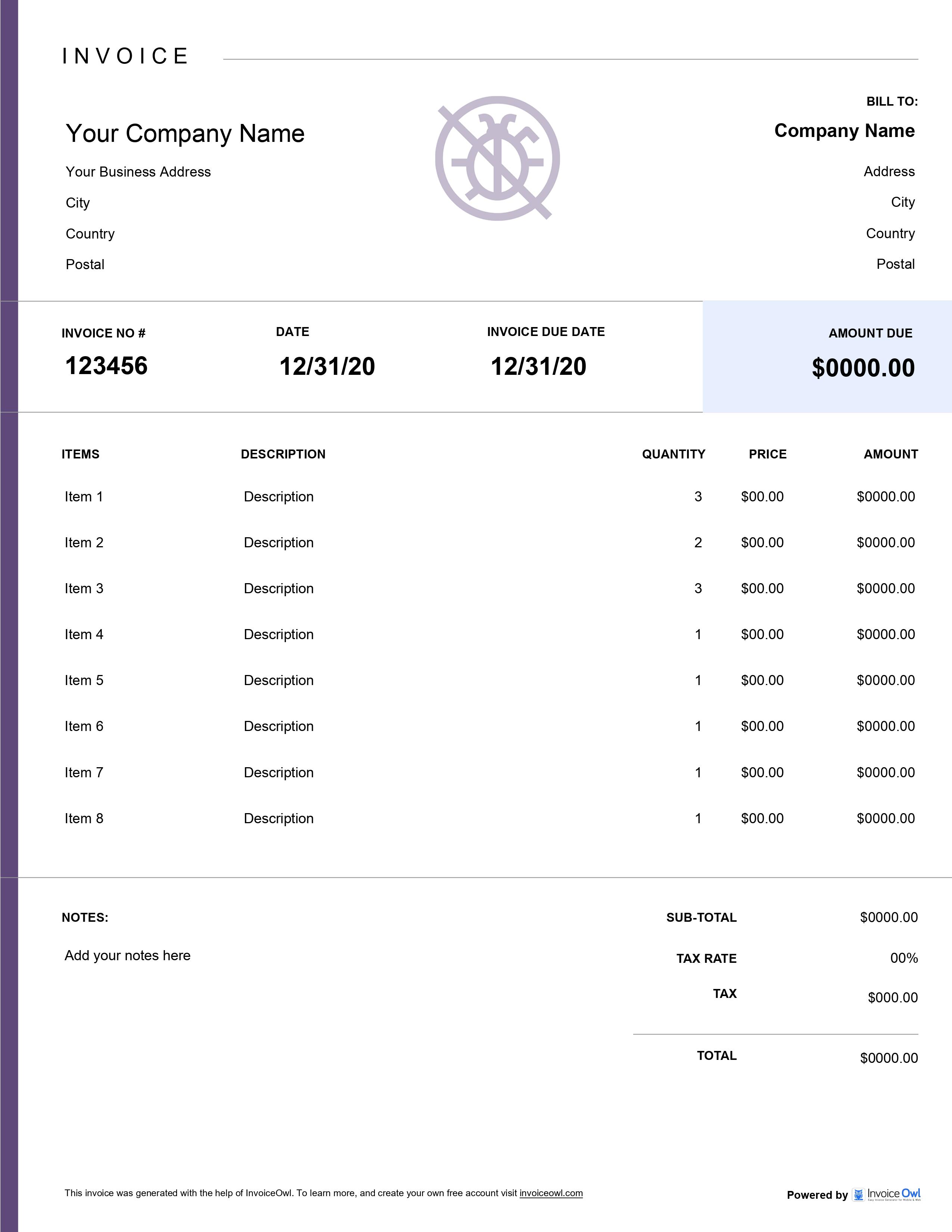
An itemized, written estimate wins jobs at higher prices than a number quoted over the phone, because the customer can see what they're paying for. Use a free estimate generator or a ready-made pest control estimate template so every quote goes out looking consistent and professional.
For larger termite or exclusion jobs, ask for a deposit up front — accepting card or online payments at booking removes the awkward chase later. For recurring plans, get the service agreement signed before the first treatment.
Quote Pest Control Jobs in Minutes, Not Evenings
InvoiceOwl lets you build itemized pest control estimates on your phone, get them e-signed, convert them to invoices in one tap, and collect payment online.
Start Your FREE TrialWorked Example: Pricing a Quarterly General Pest Plan
Say you're quoting a quarterly plan for a typical 2,000 sq ft single-family home. Here's illustrative math for one recurring visit — plug in your own numbers:
- Time on site: 30 minutes × $30/hr fully loaded labor = $15
- Drive time: 20 minutes average between stops = $10
- Chemicals and materials: perimeter treatment plus bait refresh = $8
- Overhead: $2,400/month ÷ 120 jobs = $20 per job
- Cost per visit: $53
- At a 30% profit margin: $53 ÷ 0.70 ≈ $76 per visit
Notice how sensitive that price is to route density. Cut average drive time to 10 minutes and run 150 jobs on the same overhead, and your cost drops to about $42 — you could charge the same $76 and bank the difference, or price at $65 and win more of the neighborhood.
Price the initial visit separately — say 75 minutes on site with inspection and a heavier first application — and it lands around $150–$180 with the same math. That's why the industry-standard "higher initial, lower recurring" structure exists: it mirrors the real costs.
When to Charge More
Standard rates assume standard conditions. Build explicit upcharges for the situations that take more time and product:
One caution on the regulatory side: pesticide application is licensed work, and what you must be certified for — and what you're allowed to apply — varies by state. Keep your certifications current and factor renewal costs and required continuing education into your overhead. When in doubt, verify with your state's pesticide regulatory agency.
Turning Good Pricing Into a Good Business
Pricing is only half the job — the other half is running the paperwork so the price you quoted is the money you collect. Send the estimate the same day you inspect, invoice as soon as the work is done, and track which quotes convert. If you're just getting set up, our guide on how to start a pest control business covers licensing, insurance, and equipment, and estimating software keeps your quotes, invoices, and customer records in one place once the route starts filling up. When it's time to bill, a pest control invoice template keeps everything consistent.
Frequently Asked Questions
Build it from your costs: labor for the full visit including drive time, chemicals, and overhead per job, plus your margin. For a typical single-family home, that math usually lands somewhere in the $100–$300 range that national cost guides report — but your number should come from your costs, not the guide. One-time visits should always cost more per visit than plan visits, because they carry the whole trip in one price.
The initial visit takes longer — it includes the inspection, treating the interior and exterior, and often knocking down an active problem — and it uses more product than a maintenance stop. Charging $150–$300 for the initial and less for recurring visits matches the real cost of each visit.
Cost out one recurring visit (labor on site, drive time, materials, overhead per job), apply your margin, and confirm the initial visit is priced separately and higher. Then check the result against your local market. Quarterly plans commonly land between $100 and $175 per visit nationally, but the profitable price for your business depends heavily on how tight your route is.
There's no single right number, but service businesses generally need a healthy double-digit net margin to fund equipment, slow seasons, and growth. Decide your target deliberately, price to hit it, and check your real results with a profit margin calculator — margin erodes quietly through free re-services, drive time, and product waste.
It depends on the job and your market. Free inspections are common for termites and general pest quotes because they win work, but the hour still costs you money — so either build it into the treatment price or charge for it. For specialty inspections that produce a report (like real-estate termite letters, where your state allows them), charging a fee is standard.
For one-time jobs, collect on completion — card readers or online payment links get you paid before you leave the driveway. For recurring plans, put customers on auto-billing per visit or per quarter. Invoicing software that converts your estimate straight into an invoice removes the re-typing step where errors and delays creep in.
Related Resources

A Complete Guide on How to Bid on Plumbing Jobs
Want to know how to bid on plumbing jobs in a professional way? Learn how specific plumbing jobs differ and how to calculate pricing in seconds.
Read more
How to Price Appliance Repair Jobs? (Service Calls, Parts & Profit)
Learn how to price appliance repair jobs — setting your service call fee, building a loaded labor rate, marking up parts, and quoting flat-rate repairs that actually turn a profit.
Read more
How to Price Drywall Jobs: Everything About Drywall Pricing & Estimation
Learn how to price drywall jobs and what factors you should consider as a drywall contractor when estimating drywall costs.
Read more
How to Price Tree Service Jobs? (7 Steps to Profitable Bids)
Learn how to price tree service jobs step by step — crew labor, equipment, disposal, and risk — with worked examples for removals, trimming, and stump grinding.
Read more
15 Best Flooring Estimating Software: Complete Guide
Compare the top 15 flooring estimating software solutions. Detailed reviews, pricing, and features to help contractors make informed decisions.
Read more
Estimating Handyman Jobs in 2026 - Pricing Strategy
How you estimate your handyman jobs decides wether you get the job or not. If you want to learn how to estimate your handyman services for accuracy and profit, here is the pricing strategy for you.
Read more
How to Bid a Paint Job- Complete Estimation Process
Master bidding for paint jobs with expert insights on pricing, materials, labor, and insurance. Complete guide for painting contractors to boost profitability.
Read more![How to Estimate Carpentry Jobs [Pricing Guide]](/images/2022/06/how-to-estimate-carpentry-jobs.jpg)
How to Estimate Carpentry Jobs [Pricing Guide]
You should know how to estimate a carpentry job before you even start marketing your services. As it not only helps you get new clients but also defines your client base. So, here is a guide to price your job.
Read moreA Complete Guide on How to Bid on Plumbing Jobs
Want to know how to bid on plumbing jobs in a professional way? Learn how specific plumbing jobs differ and how to calculate pricing in seconds.
Read moreHow to Price Appliance Repair Jobs? (Service Calls, Parts & Profit)
Learn how to price appliance repair jobs — setting your service call fee, building a loaded labor rate, marking up parts, and quoting flat-rate repairs that actually turn a profit.
Read moreHow to Price Drywall Jobs: Everything About Drywall Pricing & Estimation
Learn how to price drywall jobs and what factors you should consider as a drywall contractor when estimating drywall costs.
Read moreHow to Price Tree Service Jobs? (7 Steps to Profitable Bids)
Learn how to price tree service jobs step by step — crew labor, equipment, disposal, and risk — with worked examples for removals, trimming, and stump grinding.
Read more15 Best Flooring Estimating Software: Complete Guide
Compare the top 15 flooring estimating software solutions. Detailed reviews, pricing, and features to help contractors make informed decisions.
Read moreEstimating Handyman Jobs in 2026 - Pricing Strategy
How you estimate your handyman jobs decides wether you get the job or not. If you want to learn how to estimate your handyman services for accuracy and profit, here is the pricing strategy for you.
Read moreHow to Bid a Paint Job- Complete Estimation Process
Master bidding for paint jobs with expert insights on pricing, materials, labor, and insurance. Complete guide for painting contractors to boost profitability.
Read moreHow to Estimate Carpentry Jobs [Pricing Guide]
You should know how to estimate a carpentry job before you even start marketing your services. As it not only helps you get new clients but also defines your client base. So, here is a guide to price your job.
Read moreA Complete Guide on How to Bid on Plumbing Jobs
Want to know how to bid on plumbing jobs in a professional way? Learn how specific plumbing jobs differ and how to calculate pricing in seconds.
Read moreHow to Price Appliance Repair Jobs? (Service Calls, Parts & Profit)
Learn how to price appliance repair jobs — setting your service call fee, building a loaded labor rate, marking up parts, and quoting flat-rate repairs that actually turn a profit.
Read moreHow to Price Drywall Jobs: Everything About Drywall Pricing & Estimation
Learn how to price drywall jobs and what factors you should consider as a drywall contractor when estimating drywall costs.
Read moreHow to Price Tree Service Jobs? (7 Steps to Profitable Bids)
Learn how to price tree service jobs step by step — crew labor, equipment, disposal, and risk — with worked examples for removals, trimming, and stump grinding.
Read more15 Best Flooring Estimating Software: Complete Guide
Compare the top 15 flooring estimating software solutions. Detailed reviews, pricing, and features to help contractors make informed decisions.
Read moreEstimating Handyman Jobs in 2026 - Pricing Strategy
How you estimate your handyman jobs decides wether you get the job or not. If you want to learn how to estimate your handyman services for accuracy and profit, here is the pricing strategy for you.
Read moreHow to Bid a Paint Job- Complete Estimation Process
Master bidding for paint jobs with expert insights on pricing, materials, labor, and insurance. Complete guide for painting contractors to boost profitability.
Read moreHow to Estimate Carpentry Jobs [Pricing Guide]
You should know how to estimate a carpentry job before you even start marketing your services. As it not only helps you get new clients but also defines your client base. So, here is a guide to price your job.
Read more