
Key Takeaways
- 01A profitable appliance repair price has four parts: a service call fee that covers the trip and diagnosis, a fully loaded labor rate, marked-up parts, and enough margin to fund the business
- 02Published guides put a typical service call at $70–$130 and most completed repairs between $100 and $400 — but your prices must come from your costs, not a national average
- 03Charge the diagnostic fee on every visit and credit it toward the repair if the customer proceeds — free diagnosis means you work for nothing every time someone declines
- 04Quote customers a flat, per-job price built from your internal hourly cost — homeowners say yes to a firm number and no to an open meter
- 05Parts are a profit line, not a pass-through: shops commonly mark up parts to cover sourcing time, stock, returns, and warranty risk
To price an appliance repair job, start with a service call fee that pays for the drive and the diagnosis, quote the repair itself as a flat price built from your loaded labor cost and marked-up parts, and credit the service fee toward the job if the customer says yes. Published cost guides put a typical service call at $70–$130 and most completed repairs in the $100–$400 range, with big jobs like a refrigerator compressor running $700 or more — useful context, but your bottom line has to be built from your own numbers.
This guide walks through each piece: the service call fee, the loaded labor rate, parts markup, and flat-rate quoting, with a worked refrigerator repair example and the pricing mistakes that quietly sink new repair businesses.
What Goes Into an Appliance Repair Price
Every repair ticket is covering six real costs, whether you've written them down or not:
- The trip — drive time, fuel, and vehicle wear. In appliance repair you can burn a third of the day between jobs, and windshield time is a cost only your service call fee can recover.
- Diagnosis — the skilled part of the trade. Twenty minutes with a multimeter that pinpoints a failed evaporator fan is worth more than an hour of guessing, and your pricing should treat diagnosis as billable expertise, not a free sales pitch.
- Labor — priced at a fully loaded rate: wages plus payroll taxes, insurance, and benefits, not base pay.
- Parts — the part's cost plus a markup that covers sourcing time, shipping, stocking your truck, returns, and the warranty you give on the fix.
- Overhead — insurance, phone, software, marketing, tools, and licensing, spread across the jobs you complete each month. Our guide on how to calculate overhead costs walks through the math.
- Profit — the margin that funds slow weeks, replaces your van, and pays you as the owner on top of your wrench-turning wage.
Waiving the service call fee "to be competitive" means every declined repair is a trip you paid to make. Charge the fee on every visit, then credit it toward the repair when the customer proceeds. Customers accept this readily when it's stated up front — and the ones who won't pay a diagnostic fee were unlikely to approve a repair anyway.
Know the Going Rates for Appliance Repair
You price from your costs, but you sell into a market. Published cost guides tell homeowners roughly what repairs cost nationally, and it helps to know what your customer has already read before you arrive:
Typical Published Price Ranges for Appliance Repairs
| Repair | Typical Published Range | What Moves the Price |
|---|---|---|
| Service call / diagnosis | $70–$130 | Distance, after-hours, appliance type |
| Refrigerator | $125–$500 (compressor jobs $700+) | Sealed-system work, part cost, access |
| Washer | $150–$350 | Bearings and drums cost more than valves and switches |
| Dryer | $120–$300 | Heating elements, motors, vent condition |
| Dishwasher | $140–$300 | Pumps and control boards at the high end |
| Oven / range | $100–$600 | Gas vs. electric, control boards, igniters |
Treat these as context, not a price list. Averages say nothing about your market, your insurance, or the 20-year-old built-in wall oven in front of you. Hourly labor in the trade is commonly published at $50–$125 per hour — and if your loaded costs put you at the top of that range, that's where you price.
How to Price an Appliance Repair Job in 7 Steps
Set Your Service Call Fee
Add up what an average visit costs you before any repair happens: round-trip drive time at your loaded labor rate, fuel and vehicle cost, and the 30–60 minutes of diagnosis. That total is the floor for your service call fee. Most markets support $70–$130; charge it on every visit and state clearly that it's credited toward the repair if the customer approves the work.
Calculate Your Fully Loaded Labor Rate
Take the technician's wage and add payroll taxes, insurance, and benefits to get the true hourly cost — a tech paid $25/hour costs the business substantially more once the burden is added. Use our free labor cost calculator to get the loaded number. This is your internal cost rate, not your billed rate; the billed rate comes after overhead and margin.
Add Overhead per Billable Hour
Total your monthly overhead — van payment, insurance, phone, software, advertising, tool replacement — and divide by the hours you actually bill in a month, not the hours you work. If overhead runs $4,000 a month and you bill 100 hours, every billed hour must carry $40 of overhead. Skipping this step is why busy repair techs still end the month broke.
Price Parts With a Markup
Never pass parts through at cost. The part's price to the customer has to cover your sourcing time, shipping, the parts you stock but haven't sold, failed-part returns, and the labor warranty you give on the fix. Marking up parts — commonly anywhere from 25% to 100%, with higher percentages on cheap parts and lower ones on expensive boards and compressors — is standard practice across the trade. Our markup calculator does the arithmetic.
Build the Flat-Rate Quote
Estimate the repair's bench time, multiply by your loaded labor rate plus overhead per hour, add the marked-up part, then apply your profit margin. Quote the customer one firm number for the completed repair — not an hourly rate with the meter running. Flat pricing rewards you for being fast, and customers approve a firm $260 far more readily than "$95 an hour plus parts, however long it takes."
Set a Minimum Job Charge
Some fixes take ten minutes — a new fill hose, a door switch. Price them at your minimum, not at ten minutes of labor: the customer is paying for the trip, the diagnosis, and the confidence the fix is right, not for elapsed time. Your minimum job charge should usually land near your service call fee plus half an hour of billed labor.
Put It in Writing Before You Open the Toolbox
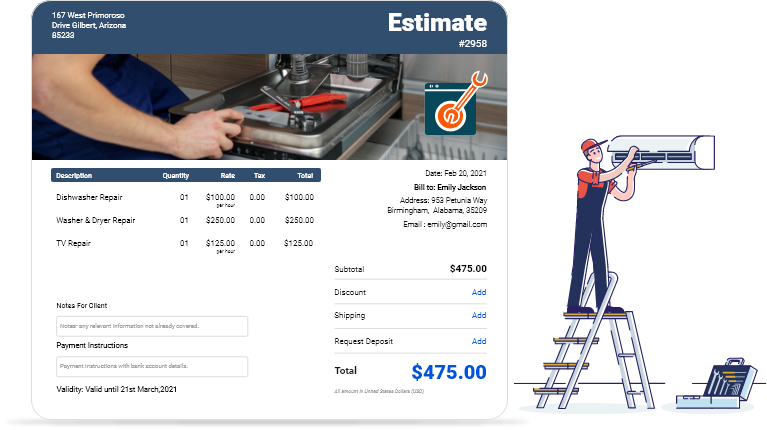
Quote the repair as a written, itemized estimate — diagnosis, labor, part, tax — and get approval before the work starts. It prevents the "you said it would be less" argument and creates the paper trail that gets you paid. Build and send one from your phone in the customer's kitchen with a free estimate generator, or start from a ready-made appliance repair estimate template.
A Worked Example: Refrigerator Evaporator Fan Replacement
Say a customer's refrigerator is warm on top and the freezer is fine. You diagnose a failed evaporator fan motor. Here's what a sound flat-rate quote might look like — the numbers are an example of the method, not market data:
Example Cost Sheet: Evaporator Fan Replacement
| Line | Math | Amount |
|---|---|---|
| Service call (already collected) | Credited toward the job | $95 |
| Bench labor | 1.25 hours × $38/hr loaded cost | $48 |
| Overhead share | 1.25 hours × $40/hr | $50 |
| Part: evaporator fan motor | $45 cost × 1.6 markup | $72 |
| Job cost subtotal | $170 | |
| Margin (40% markup on cost) | $170 × 0.40 | $68 |
| Repair price quoted | cost + margin + credited call fee | $333 |
| Customer pays on completion | $333 − $95 already paid | $238 |
The customer heard "$333 total for the completed repair, and the $95 you've already paid comes off that." That's an easy yes — and every line of it is covered, including the drive over and the 30-day labor warranty you're offering on the fix.
Some repairs shouldn't be sold. When a 12-year-old washer needs a $400 bearing job, tell the customer — a repair priced above roughly half the cost of a comparable new appliance is usually a bad buy, and saying so earns you the referral and the next repair. Honest walk-aways are marketing you don't have to pay for.
Flat Rate or Time and Materials?
Nearly every successful appliance repair business quotes customers flat, per-job prices and uses hourly math only internally. The reasons:
- Customers decide faster. A firm number is a yes/no decision. An hourly rate is an anxiety generator.
- Speed pays you, not the customer. If experience lets you do a 90-minute job in 50 minutes, flat-rate pricing keeps the difference.
- Callbacks are cleaner. A flat price with a stated labor warranty avoids arguing over whether the second visit is billable.
Time-and-materials billing still makes sense for genuinely open-ended work — chasing an intermittent fault, or commercial accounts that prefer hourly terms. For a deeper comparison, see our guide on flat rate vs. hourly pricing.
Common Pricing Mistakes That Sink Repair Businesses
- Free diagnosis. Every declined job becomes a free trip. Charge the call fee, credit it on approval.
- Pricing parts at cost. The markup is what pays for sourcing, stock, returns, and warranty risk. At cost, every part you touch loses money.
- Ignoring drive time. Five jobs scattered across the county can gross less than three in one zip code. Cluster your route and let your minimum charge protect the outliers.
- Copying the competitor's prices. The guy $40 cheaper may be uninsured, unlicensed, or three months from quitting. His price tells you nothing about your costs.
- No written estimate. Verbal quotes turn into disputes at the door. An itemized, approved estimate — ideally e-signed on the spot — is what gets your invoice paid without argument.
- Never raising prices. Parts, fuel, and insurance go up every year. Review your service call fee and labor rate at least annually — a $10 bump on the call fee across 400 calls a year is $4,000 you were leaving on the table.
Quote Repairs On-Site — and Get Paid Before You Leave
Build itemized appliance repair estimates in the customer's kitchen, get them e-signed, convert to an invoice in one tap, and take card payment on the spot with InvoiceOwl.
Start Your FREE TrialTurning Good Pricing into a Good Business
Pricing only works if the paperwork keeps up with the wrench. Quote in the kitchen, get the estimate e-signed, and collect on completion — estimating software turns the approved estimate into an invoice in a tap, and accepting card payments on the spot beats chasing checks all month. A ready-made appliance repair invoice template keeps the final bill as professional as the quote.
Then track every job: actual time against quoted time, part cost against part price. After a few dozen tickets you'll know exactly which repairs earn their keep, and your flat-rate book will be sharper than any published guide. If you're still building out the business side, our guides on starting an appliance repair business and appliance repair profitability pick up where pricing leaves off.
Frequently Asked Questions
Most markets support a service call fee in the $70–$130 range, which covers the trip and the diagnosis. Build yours from your real costs: round-trip drive time at your loaded labor rate plus fuel and vehicle cost plus 30–60 minutes of diagnostic work. Charge it on every visit and credit it toward the repair when the customer approves the job.
Quote customers a flat, per-job price and keep the hourly math internal. Homeowners approve firm numbers faster, flat pricing pays you for speed and experience, and warranty visits are cleaner to handle. Reserve hourly billing for genuinely open-ended diagnostics or commercial accounts that ask for it.
Common practice in the trade runs from about 25% on expensive parts like compressors and control boards up to 100% or more on cheap parts like belts and switches. The markup pays for sourcing time, shipping, truck stock, returns, and the labor warranty you give on the repair — a part sold at cost is a part that loses money.
A common rule of thumb: if the repair costs more than about half the price of a comparable new appliance — especially on a unit past the midpoint of its expected life — recommend replacement. You give up one ticket and usually gain a customer for life, because almost nobody in this trade tells people not to spend money.
The diagnosis shouldn't be — it's the skilled half of the job, and a free one means every declined repair is an unpaid trip. The written estimate itself costs you nothing once diagnosis is done, so present it free, and credit the diagnostic fee against the repair on approval. Our article on whether estimates should be free covers the trade-offs in more depth.
Decide your warranty policy before it happens and print it on the estimate: commonly 30–90 days on labor and whatever warranty the part carries. If your part or diagnosis was wrong, the return visit is on you; if a different component failed later, that's a new diagnosis and a new quote. A written policy turns an awkward doorstep argument into a sentence you point to.
Related Resources

A Complete Guide on How to Bid on Plumbing Jobs
Want to know how to bid on plumbing jobs in a professional way? Learn how specific plumbing jobs differ and how to calculate pricing in seconds.
Read more
How to Price Drywall Jobs: Everything About Drywall Pricing & Estimation
Learn how to price drywall jobs and what factors you should consider as a drywall contractor when estimating drywall costs.
Read more
How to Price Pest Control Jobs? (7 Steps to Profitable Pricing)
Learn how to price pest control jobs step by step — labor, chemicals, drive time, and overhead — with worked examples for one-time visits and recurring plans.
Read more
How to Price Tree Service Jobs? (7 Steps to Profitable Bids)
Learn how to price tree service jobs step by step — crew labor, equipment, disposal, and risk — with worked examples for removals, trimming, and stump grinding.
Read more
15 Best Flooring Estimating Software: Complete Guide
Compare the top 15 flooring estimating software solutions. Detailed reviews, pricing, and features to help contractors make informed decisions.
Read more
Estimating Handyman Jobs in 2026 - Pricing Strategy
How you estimate your handyman jobs decides wether you get the job or not. If you want to learn how to estimate your handyman services for accuracy and profit, here is the pricing strategy for you.
Read more
How to Bid a Paint Job- Complete Estimation Process
Master bidding for paint jobs with expert insights on pricing, materials, labor, and insurance. Complete guide for painting contractors to boost profitability.
Read more![How to Estimate Carpentry Jobs [Pricing Guide]](/images/2022/06/how-to-estimate-carpentry-jobs.jpg)
How to Estimate Carpentry Jobs [Pricing Guide]
You should know how to estimate a carpentry job before you even start marketing your services. As it not only helps you get new clients but also defines your client base. So, here is a guide to price your job.
Read moreA Complete Guide on How to Bid on Plumbing Jobs
Want to know how to bid on plumbing jobs in a professional way? Learn how specific plumbing jobs differ and how to calculate pricing in seconds.
Read moreHow to Price Drywall Jobs: Everything About Drywall Pricing & Estimation
Learn how to price drywall jobs and what factors you should consider as a drywall contractor when estimating drywall costs.
Read moreHow to Price Pest Control Jobs? (7 Steps to Profitable Pricing)
Learn how to price pest control jobs step by step — labor, chemicals, drive time, and overhead — with worked examples for one-time visits and recurring plans.
Read moreHow to Price Tree Service Jobs? (7 Steps to Profitable Bids)
Learn how to price tree service jobs step by step — crew labor, equipment, disposal, and risk — with worked examples for removals, trimming, and stump grinding.
Read more15 Best Flooring Estimating Software: Complete Guide
Compare the top 15 flooring estimating software solutions. Detailed reviews, pricing, and features to help contractors make informed decisions.
Read moreEstimating Handyman Jobs in 2026 - Pricing Strategy
How you estimate your handyman jobs decides wether you get the job or not. If you want to learn how to estimate your handyman services for accuracy and profit, here is the pricing strategy for you.
Read moreHow to Bid a Paint Job- Complete Estimation Process
Master bidding for paint jobs with expert insights on pricing, materials, labor, and insurance. Complete guide for painting contractors to boost profitability.
Read moreHow to Estimate Carpentry Jobs [Pricing Guide]
You should know how to estimate a carpentry job before you even start marketing your services. As it not only helps you get new clients but also defines your client base. So, here is a guide to price your job.
Read moreA Complete Guide on How to Bid on Plumbing Jobs
Want to know how to bid on plumbing jobs in a professional way? Learn how specific plumbing jobs differ and how to calculate pricing in seconds.
Read moreHow to Price Drywall Jobs: Everything About Drywall Pricing & Estimation
Learn how to price drywall jobs and what factors you should consider as a drywall contractor when estimating drywall costs.
Read moreHow to Price Pest Control Jobs? (7 Steps to Profitable Pricing)
Learn how to price pest control jobs step by step — labor, chemicals, drive time, and overhead — with worked examples for one-time visits and recurring plans.
Read moreHow to Price Tree Service Jobs? (7 Steps to Profitable Bids)
Learn how to price tree service jobs step by step — crew labor, equipment, disposal, and risk — with worked examples for removals, trimming, and stump grinding.
Read more15 Best Flooring Estimating Software: Complete Guide
Compare the top 15 flooring estimating software solutions. Detailed reviews, pricing, and features to help contractors make informed decisions.
Read moreEstimating Handyman Jobs in 2026 - Pricing Strategy
How you estimate your handyman jobs decides wether you get the job or not. If you want to learn how to estimate your handyman services for accuracy and profit, here is the pricing strategy for you.
Read moreHow to Bid a Paint Job- Complete Estimation Process
Master bidding for paint jobs with expert insights on pricing, materials, labor, and insurance. Complete guide for painting contractors to boost profitability.
Read moreHow to Estimate Carpentry Jobs [Pricing Guide]
You should know how to estimate a carpentry job before you even start marketing your services. As it not only helps you get new clients but also defines your client base. So, here is a guide to price your job.
Read more